Kubernetes - going beyond the basics
summary
Covers concrete ways to control placement (labels, nodeAffinity, taints/tolerations, pod anti‑affinity, or a custom scheduler), enforces policies via validating webhook demoed with an Azure Function that blocked a bad image then allowed a fixed image, extends the API with CRDs plus controllers/operators, and demonstrates a virtual node backed by Azure Container Instances where sudden load spiked and pods launched into ACI within seconds then drained back after ~60–90s; also compares HPA/vPA/cluster autoscaler and mentions Istio/App Mesh features.
AI-written summary · about
chapters (25)
- 0:00Intro
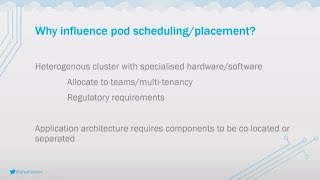
- 2:56Scheduling pods
- 4:09Approaches to influencing pod scheduling
- 4:31Node selector
- 6:06Node affinity/anti-affinity
- 7:14Specifying demand for node
- 9:02Taints & Tolerations
- 13:09Taints vs Node affinity
- 19:44Pod distribution
- 20:11Custom scheduler
- 21:10Taking more control...
- 22:01Admissions controllers
- 23:43API request lifecycle
- 25:18Admission Webhooks
- 32:50Custom Resource Definitions (CRDS)
- 34:18Creating a Foo resource
- 35:34Custom controllers
- 37:23Writing your own operator?
- 41:39Virtual Kubelet implementations
- 43:05Bursting load using virtual node
- 43:40Virtual node public preview
- 51:00Virtual node recap
- 52:05Improving service to service communications
- 53:56What is a Service mesh?
- 54:34Istio service mesh
related talks
 52mKubernetes - going beyond the basics
 50mKubernetes - going beyond the basics
 01h 01mKubernetes – going beyond the basics
 24mK8s Pod Scheduling - Deep Dive
 01h 40mInside Kubernetes Architecture Fundamentals
 39mIntroduction to Kubernetes
 45mKubernetes Resiliency
 52m8 Steps to Become Awesome with Kubernetes