Kubernetes – going beyond the basics

summary
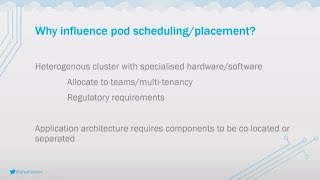
Covers concrete knobs and demos: nodeSelector/nodeAffinity, taints/tolerations, pod affinity/anti‑affinity and a custom scheduler option; shows admission webhooks with a validating webhook rejects specific image example running as an Azure Function; explains CRDs + controllers/operators for extending the API; compares HPA/VPA/cluster-autoscaler and shows KEDA in action — KEDA scales consumer from 0 to 30 and back to 0 triggered by RabbitMQ; shows burst capacity via virtual node using Azure Container Instances and that it actually scales out and back in.
AI-written summary · about
chapters (29)
- 0:00Start
- 0:34Shahid Iqbal
- 3:42Pod Scheduling
- 6:53Custom Labels
- 7:59Node Affinity
- 13:17Toleration Seconds
- 15:31Inter Pod Affinity
- 16:32Topology Key
- 17:50Pod Affinity
- 20:39The Pod Spec
- 23:33Admission Controllers
- 25:12Api Request
- 27:30Admission Web Hooks
- 27:43Admission Web Hook
- 30:11Deploy the Webhook Configuration
- 33:37Open Policy Agent
- 34:53Custom Resource Definitions
- 35:40Create a Custom Resource Definition
- 36:15Create a Custom Resource
- 37:09Custom Controllers
- 38:09Aws Operator
- 38:25Custom Controller
- 39:17Scaling
- 39:44V2 Pod Autoscaler
- 39:59Vertical Pod Autoscaler
- 41:26Water Scaling Triggers
- 43:28Kubernetes Event-Driven Autoscaler
- 46:09Virtual Node
- 53:52Deployments
related talks
 50mKubernetes - going beyond the basics
 52mKubernetes - going beyond the basics
 59mKubernetes - going beyond the basics
 46mExtend Your Kubernetes With the Power of Open Source
 24mK8s Pod Scheduling - Deep Dive
 31mScaling Your Cluster (Both Ways)
 37mKEDA: Unlocking Advanced Event-Driven Scaling for Kubernetes
 41mEvent-driven autoscaling on Kubernetes with KEDA and Azure Functions