Software archaeology - Learning from the landing on the moon!
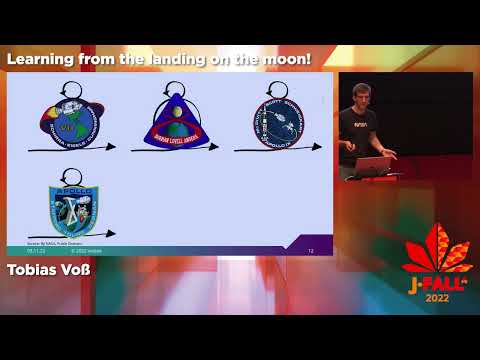
summary
The Apollo Guidance Computer is a 32 kg, 55 W 16‑bit machine with ~2 MHz clock, ~4 KB RAM and ~36 KB ROM that implements priority scheduling with seven prioritized tasks and cooperative multitasking; a built-in virtual machine provides vector/matrix and trig primitives giving ~9‑digit precision (double‑word yields ~30 cm navigation). During descent a burst of spurious rendezvous radar interrupts triggers the 1202 alarm (executive drops low‑priority jobs), the system continues and humans can override — the robust error handling saves the landing.
AI-written summary · about
chapters (8)
- 0:00Start
- 19:49AGC HARDWARE
- 31:30EXECUTIVE-REAL-TIME OPERATING SYSTEM
- 33:49INTERPRETER
- 40:57ALARMS
- 47:15MISSION CONTROL (HOUSTON)
- 47:35DIGITAL AUTOPILOT
- 48:58METHODOLOGY/PRINCIPLES STAY
related talks
 45mSoftware archaeology - Learning from the landing on the moon!
 50mSoftware archaeology - Learning from the landing on the moon!
 49mThe Charming Genius of the Apollo Guidance Computer
 47mThe AGC: A Look Back at the Computer That Took Humanity to the Moon
 47mThe AGC: Looking Back at the Computer That Took Humanity to the Moon
 49mHARDWARE in SPACE! The Kernel at the Edge of the Universe
 55mTo the Moon
 50mOrbital Rocket Guidance with Ruby