Towards Supporting Millions of Users in Modifiable Virtual Environments by
summary
Claims that Minecraft-like MVEs can scale from per-instance hundreds to millions by redesigning core simulators and rendering as serverless functions, modeling MVEs as a collection of services, and using state synchronizers with specialized consistency models. Evidence: Minecraft has 126 million monthly players but individual instances cap at a few hundred and a virtual festival crashed when ~100k simultaneous join attempts occurred. Discusses using cloudlets, Lambda shared filesystems and targeted research on terrain generation and simulators.
AI-written summary · about
chapters (14)
- 0:00Intro
- 0:48Gaming by the Numbers
- 1:42Features of Modifiable Virtual Environments (MVES) are Generally Beneficial
- 3:23MVE Scalability Challenge
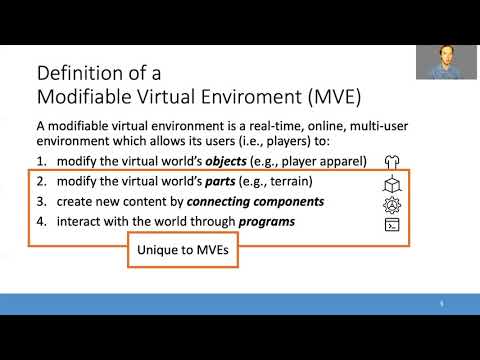
- 4:30Definition of a Modifiable Virtual Enviroment (MVE)
- 5:37Main Contributions
- 6:19Inside a Modifiable Virtual Environment
- 6:57Deployment Models and Limitations
- 8:41Serverless Operation
- 9:31Specialized Consistency Models
- 10:50Differentiated Deployment
- 11:47Serverless functions for independent scheduling of MVE services
- 13:13Dynamic consistency units to control and limit MVE inconsistency
- 13:52Schedule services at cloudlets to resources to improve QoS and cost
related talks
 30mGaming at Scale: What we learned from building our own multiplayer environment
 32mMultiplayer to Maximize Creativity & Revenue
 17mKeynote: Scaling global games in an accelerating landscape
 33mAchieving Deeper Player Interaction with Large-Scale Worlds
 44mPvE or PvP: Multiplayer Game Design Considerations
 20mState of the Game: Multi-talent Panel pt.1
 47mPanel: Mastering Multiplayer: The Super Session
 16mThree Steps to Generate Unimaginable Scale for Cloud Gaming