ML for discrete optimization: Theoretical foundations
summary
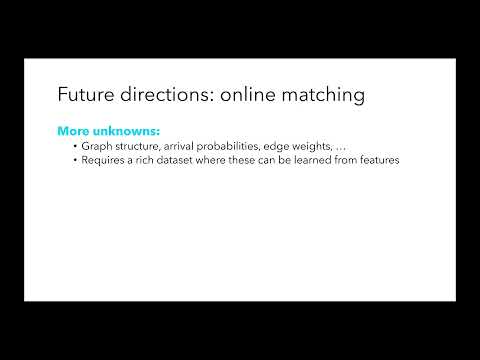
Presents two concrete methods with proofs and experiments: a GNN pipeline called MAGNOLIA trains on exponential-time marginal value-to-go labels from tiny graphs (uses GENConv, predicts each offline+skip marginal value-to-go and matches the highest) and outperforms greedy, thresholded greedy, and LP-rounding; theory shows value-to-go is nearly local on random geometric graphs so GNNs with O(log n) layers approximate it. Separately, leverages calibrated predictions and sharpness to give rent-or-buy and online scheduling algorithms whose competitive ratio or regret provably improves with calibration and predictor variance, validated on real data.
AI-written summary · about
chapters (4)
- 0:00Introduction to ML and Opt
- 9:39GNNs for online matching
- 30:10Algorithms with predictions
- 55:33Future directions and conclusion
related talks
 45mAGT and Machine Learning
 29mGraph Neural Networks + LLM on
 47mIs Minimax Optimization the Right Framework to Understand Learning in Minimax Games?
 32mLearning Ill-Conditioned Gaussian Graphical Models
 01h 01mRobustness, Stochastics, Uncertainty 2
 01h 15mImproved Machine Learning Algorithm for Predicting Ground State Properties
 23mGraph ML – The Next Level Of Machine Learning; Learn How To Use It And When Not To
 33mProvably Efficient Algorithms for Training Deep Networks