Recent Concurrency and Parallelism Proposals to the C++ Standard Committee
summary
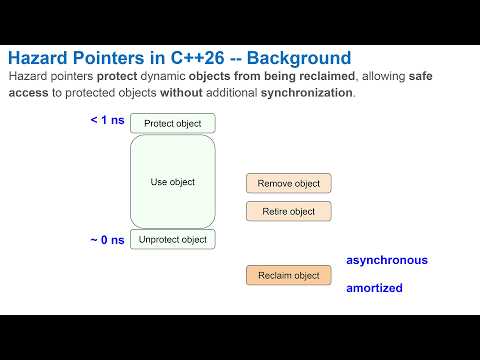
Proposal P0493 adds fetch_max/fetch_min atomics (and hints at later floating‑point variants) with hardware-backed speedups; P3135 extends hazard pointers with retire_to_cohort for synchronous reclamation plus batch create/destroy optimizations; P3125 standardizes low‑order bits as a tagged_ptr API for safe pointer tagging; P3179 and P2500 bring execution policies, range‑based parallel algorithms and a separate scheduler abstraction so code can specify how and where work runs.
AI-written summary · about
chapters (11)
- 0:00C++ concurrency proposals intro
- 1:04C++26 atomic minmax overview
- 10:12Memory ordering for atomics
- 15:06Hazard pointer extensions
- 24:29Synchronous reclamation cohorts
- 35:54Pointer tagging proposal
- 40:08Parallelism in C++ ranges
- 51:04C++26 parallel range algorithms
- 55:30Schedulers and execution policies
- 1:00:11Q&A
- 1:08:15C++26 concurrency summary
related talks
 53mThe Best We Can Do?
 16mSharpen the Spec, Cut the Code: A Case for Generative File System with SYSSPEC
 33mParallel Processors: Past & Future Connections Between LLMs and OS Kernels.
 01h 06mReflection in C++ - Past, Present, and Hopeful Future
 11mScaling Infrastructure With Confidence in the Age of AI
 56mThe Design of the Scalaz 8 Effect System
 37mGC Algorithms
 01h 03mKeynote: Why Functional Programming Matters