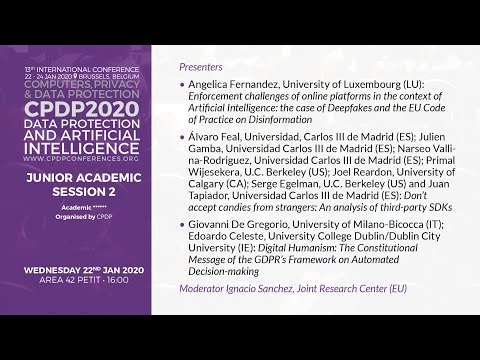
Junior Academic Session II.
summary
Three short papers give concrete findings: review of Facebook May 2019 report finds platforms mention audio‑visual manipulation but not deepfakes, rely on existing automated filters, forensic detection is immature and platforms refuse to disclose enforcement metrics; a measurement study of top 50 apps uses static and dynamic analysis to map third‑party SDKs (Facebook login in ~20% of apps, Unity3D ~7%, many apps bundle 40%+ SDKs), showing inherited permissions, identifiers and sensitive events; and a constitutional reading of Article 22 digital humanism argues GDPR protects human dignity, rule of law and due process against automated decision‑making.
AI-written summary · about
chapters (6)
- 0:00Welcome to Junior Academic Session II
- 2:10Deepfakes under EU Code of Practice
- 24:34Third-party SDK privacy risks
- 48:14Digital humanism and GDPR Article 22
- 1:07:08Q&A on AI, privacy, regulation
- 1:12:16Closing remarks
related talks
 01h 42mAcademic sessions (4)
 01h 13mFeeling ‘Unsafe’ in Online Spaces Young Peoples' Perspectives on Online Harms and ..
 01h 11mEDPL Young Scholar Award
 38mFireside Chat: Personalisation and Privacy - At Odds or Not?
 01h 17mPrivacy and New Technologies
 48mKeynote: Ethical Issues in the Law and Tech...
 52mCode and Law - A legal session on privacy, know-how and open source, Part I
 01h 01mInvestigative Journalism in the Digital Age: Privacy, Security and the Media