Ray-tracing and special relativity: Rendering objects near the speed of light!
summary
A modified ray-tracer converts pixel rays to 4D, applies a Lorentz 4×4 transform to move into the object's frame, then intersects geometry and returns colors; code lives on GitHub and produces images that match theory. Rendering a cube at 60% of c shows apparent rotation rather than simple squashing—classic Terrell rotation—and a moving sphere keeps a circular outline. Historical note: effect described by Terrell and Penrose in 1959.
AI-written summary · about
chapters (10)
- 0:00Intro
- 0:56Pinhole camera model
- 3:10Special relativity
- 4:23Thought experiment (1)
- 5:36Relativity of space and time
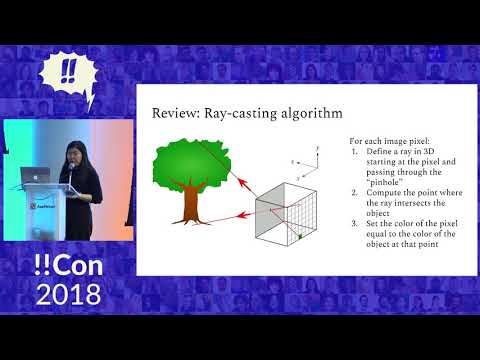
- 7:25Review: Ray-casting algorithm
- 7:36Relativistic ray-casting algorithm
- 8:36Ray-traced cube (not moving)
- 8:59Moving cube?
- 10:02Terrell rotation of spheres


