Protecting data vs systems: practicality, performance, and problems...

summary
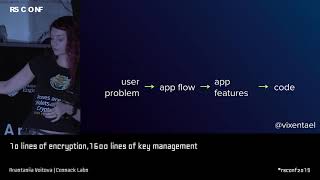
Shows a practical design that encrypts every cell with AES-GCM cell encryption and uses envelope encryption with KMS (AWS/Azure/GCP) to store a per-record data key. The KMS returns a wrapped+committed data key bound to record ID and field name so a key service can enforce ACLs via JWT and deny-by-default. Benchmarks show homomorphic comparisons ~191 ms (queries can take seconds to hours), while searchable/functional schemes (e.g. ORE/SSE) hit ~200 ns–microsecond comparisons and table scans in tens of milliseconds. Decryption runs in browser, edge, app, or proxy.
AI-written summary · about
chapters (13)
- 0:00Introduction and welcome
- 1:06Protecting systems vs data
- 3:31Challenges with system controls
- 6:23How AES-GCM encryption works
- 9:13Key management problem
- 12:02Key commitment and context
- 14:10Centralized policy with key service
- 16:17Where to perform decryption
- 18:22Querying encrypted data
- 19:03Homomorphic encryption limits
- 21:14Practical searchable encryption
- 22:57Universal policy control with encryption
- 24:24Q&A on encryption schemes
related talks
 59mDatabase Encryption in a GDPR World
 31mFast, highly effective database security using searchable encryption (without the yak shave)
 51mKeynote: Data is a new security boundary
 54mEnabling Message Level Protection at Uber
 41mCryptographic speed, reliability & security
 29mSecuring Data in Motion and at Rest: Quantifying End-to-End Encryption Perfo...
 50mBuilding Production-Grade End to End Encrypted App...
 58m10 Lines of Encryption, 1500 Lines of Key Management