Attacking Deep Learning-Based NLP Systems

summary
Demonstrates that by poisoning word embeddings — via injected Wikipedia or Twitter sentences, tampered corpora, or distributed pre-trained embeddings — an attacker can skew downstream NLP. Implements a convolutional sentiment model in PyTorch on the Stanford Sentiment Treebank, then directly shifts individual word vectors and flips movie review labels from negative to positive while overall test accuracy barely changes. Recommends provenance, reproducibility and manual data inspection as practical defenses.
AI-written summary · about
chapters (8)
- 0:00Introduction to talk
- 0:44Why NLP attacks matter
- 3:58What are word embeddings
- 10:45How word embeddings are computed
- 14:00Example attacks on NLP systems
- 20:50How to manipulate word embeddings
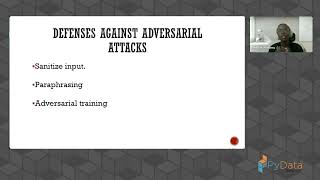
- 23:21Defenses against tampering
- 25:33Q&A session
related talks
 21mTricking Neural Networks : Explore Adversarial Attacks
 25mTricking Neural Networks : Explore Adversarial Attacks
 22mMaking Natural Language Processing Robust to Sociolinguistic Variation
 36mVulnerabilities in Deep Learning Language Models (DLLMs)
 31mThe dark side of deep learning
 46mA Short Introduction to Hacking Artificial Intelligence
 23mSecurity and auditing tools in Large Language Models (LLM)
 28mSecurity of Machine Learning