Security and auditing tools in Large Language Models (LLM)

summary
Covers concrete attacks and defenses with tools and outcomes: demonstrates prompt injection, jailbreaks, data poisoning, model inversion and extraction, and membership inference; shows a synonym swap that flips a sentiment model from positive to negative using the Tex fet attack on a P Trin B trained on the emdb Mob reviews set and then retrains with adversarial samples to regain accuracy; evaluates robustness with PRING and stop frameworks, cites a 6 million‑parameter model and a 14‑category safety classifier.
AI-written summary · about
chapters (9)
- 0:00Introduction to Security Auditing Tools
- 0:47Understanding Transformers in NLP
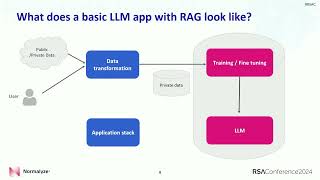
- 2:20Training and Fine-Tuning Language Models
- 3:22Security Concerns in Language Models
- 3:52Injection Attacks and Mitigation
- 8:38Adversarial Attacks on Machine Learning Models
- 15:09Tools for Evaluating Model Robustness
- 16:53Privacy and Security Auditing Tools
- 22:22Conclusion and Resources
related talks
 31mHacking with Words...
 44mI Abuse Your LLM Live with 10 Security Vulnerabilities
 47mCurrent Security Threats in Large Language Model Applications
 46mHow Large Language Models Are Reshaping the Cybersecurity Landscape
 47mA Step-by-Step Guide to Securing Large Language Models (LLMs)
 47mHarnessing LLMs for Next-Level Security Analysis
 43mLLMs in a Hacker's Hands: From Prompt Injection to Data Leakage
 50mSecuring LLM-Powered Applications: Overcoming Security and Privacy Challenges