The future of databases: Combining operational and analytical data at massive scale

summary
Explains how MariaDB Xpand uses a shared‑nothing cluster with a single proxy entry point (MaxScale) to load‑balance reads/writes, auto‑rebalance data, and survive zone failures; cites benchmarks of 860,000 writes/sec under 10 ms and 10 million reads/sec with 128 nodes under 5 ms. Describes internals: two‑phase locking, three‑phase commits (Paxos family), MVCC, and a novel columnar index that yields >10× speedup on a 1B‑row aggregation.
AI-written summary · about
chapters (10)
- 0:00Introduction and speaker intro
- 1:04Database performance challenges in 1990s
- 3:10Evolution from sharding to NoSQL
- 5:39What is distributed SQL
- 9:10MariaDB Xpand distributed SQL demo
- 13:02How Xpand handles scalability
- 17:13High availability and replication
- 18:58Performance benchmarks of Xpand
- 20:43Combining OLTP and OLAP queries
- 24:40Resources and closing
related talks
 15mModern data platforms: AWS and MariaDB SkySQL
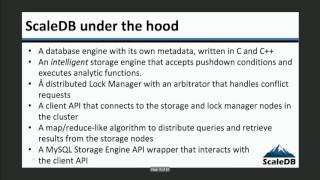 58mIntroducing ScaleDB, the New Clustered, Distributed Storage Engine for MySQL (Part 1)
 37mScale MySQL beyond limits with ProxySQL
 50mSupersized Postgres: Postgres-XL for OLTP and Big Data Analytics
 27mIntroduction to Configuring and Using MariaDB MaxScale: Database Proxy Made Simple
 32mData @Scale Seattle- Eric Hwang introduced by Ganapathy Krishnamoorthy
 29mModern Database Architecture: From SQL to NoSQL & Distributed SQL
 12mMariaDB at Percona