Open standards for machine learning deployment

summary
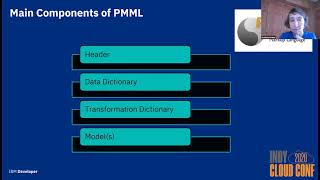
Overview of practical deployment standards: PMML (1997) is XML, supported by 30+ vendors and handles classic models but limits deep nets and forces extensions that break portability; PFA is a JSON “mini-language” (Hadrian runtime exists, export tools and an open-source artwork exporter for Spark ML) and represents complex pipelines but lacks generic higher-rank tensors and GPU ops; ONNX focuses on deep learning, gains momentum from Facebook/Microsoft/IBM/AWS and ships the ONNX Runtime for scoring, but still has gaps in text preprocessing and certain ML feature types.
AI-written summary · about
chapters (25)
- 0:00Start
- 2:12Machine Learning?
- 5:07In reality the workflow spans teams...
- 5:33and tools...
- 7:00What, Where, How?
- 8:26Pipelines, not Models
- 9:31Challenges
- 12:35Containers are The Solution... right?
- 14:01Why a standard?
- 15:15Why an Open Standard?
- 16:47Predictive Model Markup Language
- 17:42PMML - Format overview
- 18:51PMML - Coverage
- 19:29PMML - Shortcomings
- 21:04Portable Format for Analytics
- 22:12A Simple Example
- 24:12Managing State
- 25:28Other Features
- 29:26Aardpfark is open-source!
- 30:07PFA - future directions
- 30:38Open Neural Network Exchange (ONNX)
- 32:32ONNX Recent Developments
- 33:43ONNX - future directions
- 35:02Summary
- 38:15Thank you!
related talks
 33mOpen Standards for Machine Learning Deployment
 33mOpen Standards for Machine Learning Deployment
 34mOpen Standards For Machine Learning Model Deployment
 48mDeploying Machine Learning Models in Practice
 54mOne Universal Language for All Machine Learning Models
 30mApache MXNet 2.0: Towards Synergistic ML and DL with Standardization
 24mMaking Spark ML Models Portable Know Your Options
 45mLeverage Power of Machine Learning with ONNX