Future-proofed microcontroller designs with FreeRTOS

summary
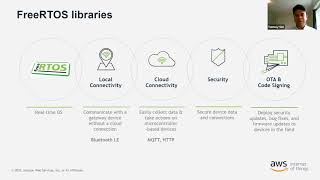
FreeRTOS has an 18‑year history and targets tiny MCUs with an 10–15 KB footprint and only tens of bytes of RAM for the kernel, and the ecosystem supports 20+ compilers and ~40 architectures. AWS IoT reference integrations bundle MQTT/TLS, PKCS#11 secure storage, and OTA via IoT Device Management; the cloud handles half a billion endpoints/month and ~half a trillion messages. Code receives memory‑safety proofs and long‑term support; libraries are modular Git repos and buildable as submodules.
AI-written summary · about
chapters (16)
- 0:00Intro
- 1:52Why is it important? 1. Designs are getting more complex 2. We need to protect our investments in bringing those designs to market
- 3:09FreeRTOS has been around a while
- 5:17Starting small ... but sophisticated
- 6:35Realizing new value: Predictive maintenance
- 10:19Another view
- 11:08Managing complexity
- 12:24Build or buy (or neither)?
- 14:46Decision criteria: Non-functional requirements
- 16:13Time to market: Check
- 16:27Sources of FreeRTOS reference integrations
- 18:34Use open standards
- 19:58Use compiler of choice and standard tooling
- 23:49Simplicity, flexibility, portability: Check
- 25:46Continuity, global presence, robust: Check
- 25:57Ensure you can patch after deployment
related talks
 38mTo RTOS, or not RTOS: That is the Question
 43mConnecting Microcontrollers to the Cloud Using MQTT, BLE, and HTTP
 38mRTOS vs Bare metal Dawn of Constrained Device
 49mWhich OS/RTOS makes sense for your Constrained Device?
 54mSqueezing Your Microcontroller
 30mSoftware architecture for High-end IoT devices
 37mTizenRT as Lightweight IoT Plaftorm
 31mEmbracing FOSS in Embedded Development: From Proprietary to Modular and Collaborative