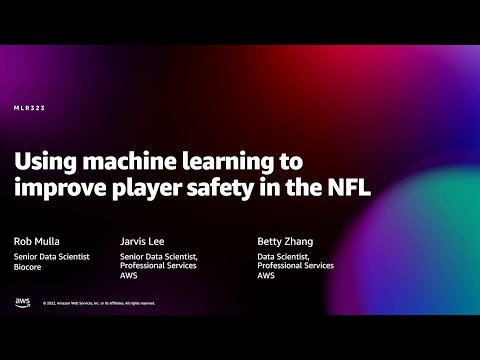
Using machine learning to improve player safety in the NFL
summary
A machine pipeline combines helmet object detection, multi-view tracking, and NGS sensor alignment to assign impacts to players, then classifies 16-frame 128×128 clips with a ResNet34 backbone and a temporal shift module, achieving ResNet34 with temporal shift performance at 2D compute. Labeling uses SageMaker Ground Truth; inference runs on AWS Batch + Step Functions with DynamoDB. The system processes seasons over 150x faster than humans and scores >10% more accurate (F1 +12%), replacing 27‑minute-per‑play manual review.
AI-written summary · about
chapters (11)
- 0:00Program overview
- 1:08Digital athlete philosophy
- 2:30Helmet impact detection
- 5:43Computer vision pipeline
- 7:32Technical detection methods
- 9:32Player assignment process
- 12:51Impact classification
- 17:18Model architecture
- 20:54Fusion and validation
- 25:58Scaling and synchronization
- 29:46Workflow and conclusion
related talks
 29mHow the NFL builds computer vision training datasets at scale
 42mHow Deep Learning is Revolutionizing Sports Analytics
 35mFootball video analysis using Deep Learning
 36mVideo analytics at scale: Deep Learning, Computer Vision, ML & Spark
 51mVideo Analytics for Football games
 38mHow We Built a Safety Violations Detection System
 28mScalable High Precision OCRs for Game Event Detections
 19mDrive transformation through machine learning