Agility is the Tool, not the Purpose
summary
Argues that agility must deliver measurable stakeholder value not just working code and shows concrete practices that work: the Evo method for managing many agile teams, using an impact estimation table to rate architectures by value‑to‑cost, and a startup ritual that quantifies a top 10 critical values with numeric targets. Cites a scrum rollout that cut sales 30% then recovered after modeling, an $160M eight‑year failure turned into success in two years, and teams that ship verified value every week.
AI-written summary · about
chapters (22)
- 0:00Agility is the Tool, Not the Master: Gilb's Ten Key Agile Principles to deliver stakeholder value, avoid bureaucracy, and give creative freedom
- 8:33Polish Papers
- 8:47Here is a recent example from our practice
- 12:24Can we understand Agile in terms of technology/PM & organisational agility and stipulate any similarities and differences.? • Traditional Agile for IT Scrum, XP - Isusfortunately not tuned in to delivering business value - As is, traditional Agile is not useful for business purposes. • The Agile IT & Business Model we recommend ( Evo') - is focused on business value delivery
- 16:02How do Lean & Agile Intersect? Agile is naturally lean and based on small batches Agile directly supports six principles of lean thinking Agile may be converted to a continuous flow system
- 18:01Agile Project Leadership Agile management is delegated to the lowest level There remain key leadership roles & responsibilities Communication.coaching and facilitation keynes
- 18:5814 PITFALLS OF AGILE METHODS
- 19:2914 PROMISES OF AGILE METHODS
- 22:14Value Decision Tables
- 29:52Gilb's Agile Principles
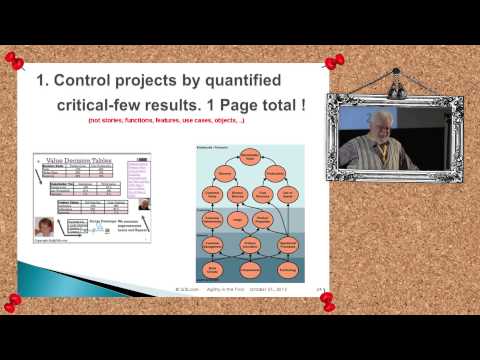
- 30:03Control projects by quantified critical-few results. 1 Page total !
- 31:52NOT LIKE THIS Project Objectives 'Unquantified few
- 38:06Make sure those results are business results, not JUST technical
- 38:17The Strategic Objectives (CTO level) Example from Ericsson Base Stations Support
- 40:39Give developers freedom
- 42:48Estimate the impacts of your designs, on your quantified goals
- 51:52Select designs with the best impacts in relation to their costs
- 52:30Decompose the workflow, into weekly (or 2% of budget) time boxes
- 54:25cíti
- 57:38Dynamic (Agile, Evo) design testing not unlike 'Lean Startup
- 58:35Change requirements, based on quantified experience, new inputs: intelligent tradeoff. Reduce the level or delivery time, of
- 58:46REAL EXAMPLE Cleanroom Method, developed by IBM's Harlan Mills (1970- 80) EARLY AGILE !!!