AuthentiCall: Efficient Identity and Content Authentication for Phone Calls
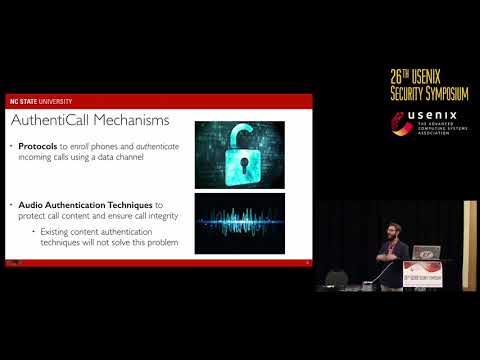
summary
System uses an auxiliary data channel (phone’s Internet connection) plus a voice challenge over the PSTN to issue short-lived certificates and perform mutual authenticated Diffie-Hellman before answering, binding voice to data with 512-bit robust digests (RSH) computed per second. Prototype flags substitutions in audio, achieving 99% tamper detection with negligible false positives and adds only 1–1.5s setup (worst-case 1.4s) to call establishment while enabling pre-answer caller identity and robocall mitigation.
AI-written summary · about
chapters (16)
- 0:00Introduction
- 2:41Root Cause
- 3:04Modern Phone Network
- 3:39Call Path
- 4:06Security Implications
- 6:51AuthentiCall
- 7:43Two Core Mechanisms
- 8:19Problem Space
- 12:29Phone Call Protocol
- 14:18Phone Call Performance
- 16:43Robust Digests
- 18:10RSH
- 19:17Safety
- 19:59Experiments
- 23:08Summary
- 23:52Questions
related talks
 27mAuthLoop: End-to-End Cryptographic Authentication for Telephony...
 26mThe Forgotten
 35mContact Center Authenticaion
 45mVoice Security - Get Up to Speed on This Attack Vector
 30mMITM On PSTN: Novel Methods For Intercepting Phone Calls
 23mWho is Calling? Identity for Agents with AAuth
 22mComplementing Passkeys with Strong Identity Assurance for High-Risk Actions and Account Recovery
 33mYour voice confirms my identity