Variable Selection with Error Control: Another Look at Stability Selection
Talkat Workshop on Succinct Data Representations and Applications (Simons Institute Big Data 2013) · 2013-09-16..09-19·
summary
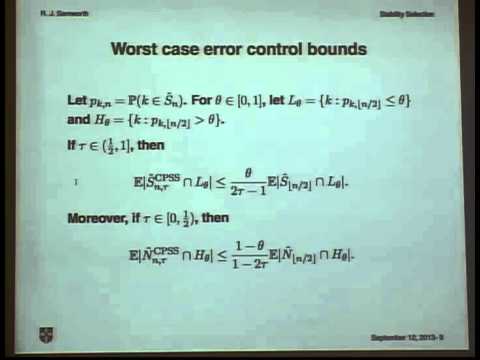
Introduces complementary-pair stability selection: apply any base selector to random half-samples and their complements, aggregate selections, and keep variables chosen at least proportion t (t>0.5). Proves a finite-sample bound on the expected number of falsely selected (low-selection-probability) variables that scales like Q·(something)/((2t−1)P), so with P=1000, Q=50 and t=0.6 the bound cuts low-probability picks to about one quarter of the base method. Improves the bound by assuming unimodality or r = -1/2 concavity; simulations (n=200, p=1000, lasso base) show better false-positive control but higher false negatives if tuned aggressively.
AI-written summary · about
chapters (20)
- 0:00VARIABLE SELECTION WITH ERROR CONTROL: ANOTHER LOOK AT STABILITY SELECTION
- 0:54What is Stability Selection?
- 4:22A general model for variable selection
- 6:15How does Stability Selection work?
- 15:09Error control discussion
- 15:45Complementary Pairs Stability Selection
- 17:07Worst case error control bounds
- 22:59Illustration and discussion
- 25:34Proof
- 30:21Bounds with no assumptions whatsoever
- 32:10Can we improve on Markov's inequality?
- 32:49Improved bound under unimodality
- 33:35Extremal distribution under unimodality
- 35:14The r-concavity constraint
- 36:57Extremal distribution under r-concavity
- 37:08T= -1/2 is sensible
- 37:53Reducing the threshold
- 39:27Simulation study
- 42:41Simulation results
- 44:04Summary
related talks
 22mPanel Discussion
 32mHypothesis selection with computational constraints
 38mWhy giving your algorithm ALL THE FEATURES does not always work
 41mGeneralization Bounds for Uniformly Stable Algorithms
 01h 01mRobustness, Stochastics, Uncertainty 1
 54mOff-the-shelf Algorithmic Stability
 01h 02mSampling for Linear Algebra, Statistics, and Optimization II
 33mBalancing Covariates In Randomized Experiments: The Gram--Schmidt Walk Design