Privacy Preserving Data Manipulation in Decentralized Systems

summary
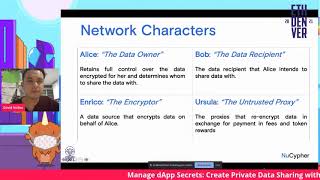
Claim: a decentralized network performs access control by holding re-encryption keys so ciphertext stays encrypted end-to-end. Implementation uses threshold proxy encryption (nodes split keys; demo uses 3-of-5 threshold), a Python repo on a federated branch, and proxy nodes that re-encrypt stored ciphertext on payment. Demo encrypts line-by-line Finnegans Wake, re-encrypts via three running nodes, and successfully lets the designated recipient decrypt—proof of concept works end-to-end.
AI-written summary · about
chapters (12)
- 0:00Start
- 0:50What We Mean by Privacy Preserving Data Manipulation
- 2:49Avoiding Unnecessary Decryption Events
- 5:14What Is the Problem with Asic Public Key Cryptography
- 10:02Underlying Cryptography
- 15:13Centralized Proxy Encryption
- 16:04The Trust Model
- 19:26Autonomous Vehicles
- 27:51Content Distribution
- 29:41Fully Homomorphic Encryption
- 30:34Multi-Party Computation
- 48:20Initializing Characters
related talks
 18mDecentralization is the New Encryption
 34mDecentralized Access Control with Medusa
 16mPrivacy Preserving AI
 01h 14mDecentralized Cryptography: A Distant Dream or an Immediate Possibility?
 19mInnovations in Privacy Technologies: The Keys To Decentralized Networks
 34mPrivacy All the Way Down: Tackling MEV at Different Layers via. Cryptography
 21mGhostor: Toward a Secure Data Sharing System from Decentralized Trust
 28mManage dApp Secrets: Create Private Data Sharing