Implementation of a Perception Module for Smart Mobility Applications in Eclipse MOSAIC

summary
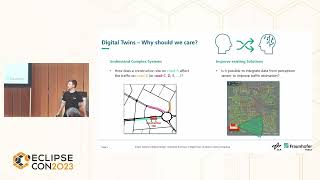
Eclipse MOSAIC gains an object-level perception module that returns detected vehicles, traffic lights and signs instead of raw sensors, implemented in the Application Simulator and callable via TraCI or Libsumo. It uses spatial indexing (grid and quadtree) for fast field-of-view queries, evaluates computational performance on a Berlin scenario, finds the grid slightly faster than quadtree, and reports Libsumo is faster than TraCI. Code and module are available on GitHub.
AI-written summary · about
chapters (10)
- 0:00Start
- 0:57Introduction
- 3:04Applications based on Object Detection
- 9:11Perception in MOSAIC Apps
- 11:08Perception Index and Module in MOSAIC Application
- 12:58Solution (Coupling with SUMO)
- 14:45Performance Evaluation (Setup)
- 16:34Spatial Index Performance (Grid vs. Quad-tree)
- 17:05SUMO Coupling Methods (TraCl vs. LibSumo)
- 17:52Conclusions
related talks
 24mLeveraging Eclipse SUMO and Eclipse MOSAIC
 24mTowards Smarter Intersections Through Digital Twins - The Coupling of SUMO and SCENIMINI
 20mTowards a Domain-specific Language for the Virtual Validation of Cloud-native Mobility Services
 42mThe Importance of Open Simulators and AI in a Changing Mobility Landscape
 15mSUMO and the Transportation GeoXchange (TGX)
 05mMVT Tiles and Autonomous Driving, and other non-UI usage
 47mEmbedded Systems Architecture
 22mC-ITS services for light rail systems