Combining microtraffic models and complex vehicular simulators
summary
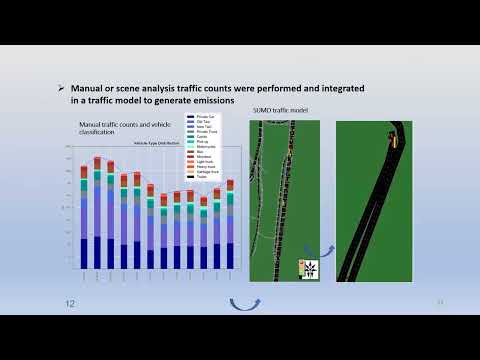
A validated pipeline uses drone video tracking to extract per-vehicle speed and acceleration traces, calibrates SUMO to reproduce observed queuing behavior, and feeds second-by-second drive cycles into ADVISOR with engine rpm–torque–emission maps to compute fuel, energy and pollutant outputs. Results show SUMO reproduces queuing theory, HC/NOx ratios shift markedly between stop‑and‑go and free flow, electric vehicles show lower sensitivity to traffic flow, and the setup yields repeatable, per-vehicle emissions and an energy‑sensitivity index via SUMO→ADVISOR coupling.
AI-written summary · about
chapters (9)
- 0:00Introduction
- 0:28Transient traffic
- 0:57Approach
- 2:58New examples
- 3:37Video tracking
- 4:55Q in theory
- 7:37Advisor
- 10:58Advisor examples
- 14:07Conclusion
related talks
 24mTowards Smarter Intersections Through Digital Twins - The Coupling of SUMO and SCENIMINI
 19mCycle-Level Distribution-Based Calibration of Microscopic Intersection Models Using UAV Trajectories
 15mSUMO and the Transportation GeoXchange (TGX)
 24mLeveraging Eclipse SUMO and Eclipse MOSAIC
 42mThe Importance of Open Simulators and AI in a Changing Mobility Landscape
 20mTowards a Domain-specific Language for the Virtual Validation of Cloud-native Mobility Services
 20mAI on the Fast Lane: Smart Traffic Systems to Unclog our Cities
 25mMulti-Vehicle Map Fusion Using GNU Radio