C-ITS services for light rail systems
summary
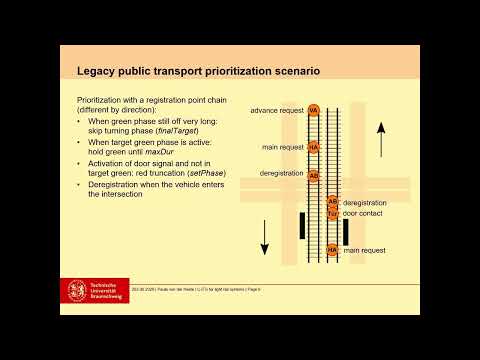
Microscopic SUMO simulation of the Nationalbibliothek (U5) intersection compares three setups: baseline, legacy TSP, and C-ITS = TSP + GLOSA. Implementation uses detectors, logged priority actions, deactivated teleports, and varied background traffic (1.0 and doubled). Legacy priority reduces tram delay but raises car time loss; C-ITS lowers overall tram delay and cut stop counts further only when GLOSA uses a long detection range — 500 m GLOSA range — shorter ranges show negligible benefit.
AI-written summary · about
chapters (14)
- 0:00Introduction to C-ITS
- 1:04Light rail systems overview
- 3:18Legacy public transport prioritization
- 5:02C-ITS services for light rail
- 7:15Case study intersection setup
- 7:59Simulation scenarios and settings
- 10:19Legacy scenario implementation
- 12:11C-ITS scenario implementation
- 14:48Green light optimal speed advisory
- 15:10Baseline scenario results
- 16:38Legacy vs C-ITS comparison
- 17:27GLOSA simulation results
- 18:42Stop count analysis
- 19:57Summary and future work
related talks
 17mSignal priority for improving fluidity and decreasing fuel consumption
 20mSimulating platooned connected autonomous vehicle in a large scale urban scenario
 15mbuilding generic traffic models for SUMO
 15mSUMO and the Transportation GeoXchange (TGX)
 13mUtilizing Vehicle Trajectory Data to Characterize Performance Measures of a Highway Corridors
 16mTopology-Preserving Simplification of OpenStreetMap Network Data for Large-scale Simulation in SUMO
 13mExtending SUMO for Lane-Free Microscopic Simulation of Connected and Automated Vehicles
 19mTestbed for Development of AI Solutions to Boost Operational Efficiency in Transportation Networks