Reactive microsystems

summary
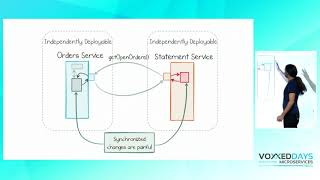
Argues for a middle path between monolith and microservices by making an append-only event journal the source of truth, splitting reads and writes, and projecting eventual-consistent views; shows a real pattern where projections and state in-process shards let a hot auction (example: Justin Bieber hair) serialize bids without DB locks. Mentions Legume framework, avoids Kafka by using simple DB append rows, and cites a customer case that shrank infrastructure from ~500 nodes to 10.
AI-written summary · about
chapters (13)
- 0:00Introduction and setup
- 1:27Reactive systems vs reactive programming
- 3:19The monolith and its limitations
- 7:03From monolith to micro leaves
- 10:46Event sourcing fundamentals
- 15:05Asynchronous event propagation
- 18:47What are reactive microsystems
- 23:11Scaling with stateful services
- 27:48Handling high concurrency
- 33:12Legume framework overview
- 37:08Applying lessons to monoliths
- 39:18Conclusion and trade-offs
- 40:24Q&A: Fault tolerance and scaling
related talks
 55mRethinking Reactive Architectures
 47mThe Rise of Reactive Microservices
 30mReacting to the future of application architecture
 54mReacting to an Event-Driven World
 50mAddressing Recent Events
 48mIntegrating microservices by accepting the data dichotomy
 52mBuilding monolith applications that could scale to microservices..
 49mMicroservices guided by DDD and reactive systems paradigm