RSocket – new Reactive cross-network Protocol

summary
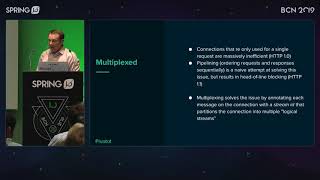
Builds a multiplayer Pac‑Man (browser client with Phaser/TypeScript, Spring Boot server, protobuf API, Kafka-style metrics pipeline) and stress-tests HTTP/1, WebSocket/socket.io, gRPC and RSocket. socket.io shows flaky latency in the demo; gRPC achieves about 150k messages/sec but accumulates direct memory and hits OOM when consumers slow, exposing gRPC’s non‑end‑to‑end backpressure. RSocket uses multiplexed streams over one connection, provides real backpressure and leasing/resume features, keeps memory small (hundreds of MB) under load, and the RSocket demo runs smoothly.
AI-written summary · about
chapters (10)
- 0:00Introduction and motivation
- 11:30Protocol comparison criteria
- 20:45WebSocket and Socket.IO limitations
- 25:27HTTP/2 and gRPC issues
- 33:38Backpressure demonstration
- 41:58Netflix’s RSocket solution
- 43:21RSocket features and benefits
- 48:57Multiplayer Pacman demo
- 50:53RSocket stress test
- 54:32Summary and Q&A
related talks
 53mRSocket - future Reactive Application Protocol?
 01h 01mThe RSocket Protocol — The Future of Reactive Applications
 47mRSocket + Spring
 42mWelcome to the Reactive Revolution:RSocket and Spring Cloud Gateway
 01h 12mRSocket + Spring: A full throttle introduction
 52mMulti Service Reactive Streams Using Spring, Reactor, and RSocket
 34mReactive Architecture
 55mThe Reactive Revolution