Agentic AI

summary
Coding agents outperform expectations thanks to strong feedback loops like type safety and unit tests, while teams that succeed treat evals as essential—distinguishing offline prompts from online tracing and product analytics. Multi-agent architectures appear useful for complex research stacks (often five or six cooperating agents) but handoffs and context passing remain unsolved. Embeddings are no longer the default—hybrid vector + filter or plain SQL/full‑text often suffice. Expect better planning, computer‑use agents that control GUIs, and RAG‑2.0 toolchains for smarter traversal and search.
AI-written summary · about
chapters (9)
- 0:00Agentic AI introduction
- 0:42Agent architectures and lessons
- 3:28When to use multi-agent systems and when to avoid them
- 7:22Memory and state in agents
- 10:36Evaluating agent reliability
- 18:20Agent anti-patterns and tools
- 21:51Non-technical agent building
- 22:53Empower AI domain experts
- 23:55Future agent capabilities
related talks
 27mAgentic Engineering: Working With AI, Not Just Using It
 16mBuilding Applications with AI Agents
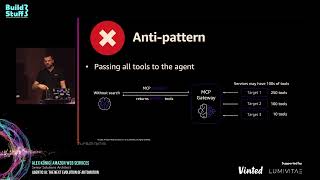 40mAgentic AI: The Next Evolution of Automation
 29mPairing with the machine: How AI Agents are rewriting the rules of software development
 26mAI Agents as Your Co-Developer
 26mAI Agents and the Future of Human-AI Collaborative Intelligence
 22mAgentic AI for Engineering Leaders | Strategy & Execution Guide
 34mAI Agents: Transforming Autonomous Decision-Making