CUDA in Python- A New Era for GPU Acceleration

summary
Concrete claims and tools: Python bindings for CUDA (nvmath-python, cccl-python, cuda-core, numba-cuda) plus cuPy, cuDF and cuPy‑numeric/Legate stack that interoperates and ships via Anaconda with CUDA 12. Examples report a telescope pipeline gaining ~23x then an extra ~16x with optimized math libs, XGBoost scaling to thousands of GPUs and 8 TB of data, and workflows that drop from days to minutes. Hardware shifts (Grace/Blackwell: 2x memory bandwidth, interconnect 900 GB → 10 TB) drive the multi‑GPU, multi‑node patterns shown.
AI-written summary · about
chapters (14)
- 0:00Introduction
- 1:25GPU Computing Basics
- 3:29Libraries for GPU Control
- 6:15Machine Learning Frameworks
- 8:26CUDA Python Ecosystem
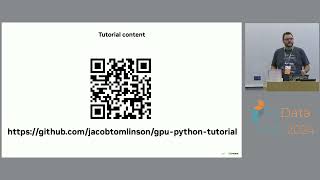
- 10:37Learning Resources
- 12:37Scientific Case Study
- 15:27Blackwell Hardware Architecture
- 18:34GPU-Centric Computing
- 20:27Multi-Node Multi-GPU Scaling
- 23:35Implicit Parallelism with Legate
- 27:56Legate Boost for XGBoost
- 32:00Legate Runtime Mechanics
- 33:33Conclusion
related talks
 02h 28mGPU Accelerated Python
 30mCUDA in Your Python: Effective Parallel Programming on the GPU
 01h 02mExploit your GPU power with PyCUDA (and friends)
 35mPython at the Speed of Light: A Complete Tour of the CUDA Ecosystem
 55mAccelerated Python: The Community and Ecosystem
 01h 02mExploit your GPU power with PyCUDA (and friends)
 34mAccelerating GPU Algorithms in pure Python
 27mBringing NVIDIA math libraries to Python scientific community