A Primer (or Refresher) On Linear Algebra for Data Science

summary
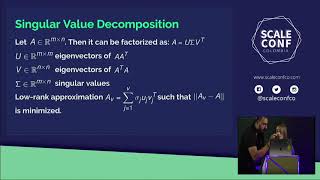
Claims that linear algebra is the foundation of many ML methods and shows concrete demos: matrix×vector as weighted column sums, a 90° rotation applied pixelwise (inefficient but illustrative), geometric least-squares as projecting Y onto the column space, and SVD for compression and regression. Uses NumPy and scikit‑learn internals (SVD/QR) and warns that computing inverses is numerically unstable—Hilbert matrix example. Image reconstruction reaches recognizability with 0.05 percent–a few singular values, using singular value decomposition, and repeats the advice don't invert matrices numerically.
AI-written summary · about
chapters (8)
- 0:00Linear algebra relevance
- 2:35Matrices and vectors
- 7:13Matrix multiplication
- 7:54Linear regression geometry
- 13:39Matrix factorization
- 21:31SVD and regression
- 24:26Further learning
- 27:39Q&A
related talks
 35mA Crash Course in Applied Linear Algebra
 32mRandomized Numerical Linear Algebra: Overview
 01h 00mAdventures in Linear Algebra++ and Unsupervised Learning
 43mThe Linear Algebra of Deep Learning
 34mThe Linear Algebra of Deep Learning
 01h 02mTheory and Big Data
 01h 03mSampling for Linear Algebra, Statistics, and Optimization I
 01h 27mPast, Present and Future of Randomized Numerical Linear Algebra I