How to Trick a Neural Network

summary
Implements the adversarial-examples recipe from "Explaining and Harnessing Adversarial Examples" using GoogleNet downloaded into Caffe and runnable as a Jupyter notebook / Docker image, showing that tiny iterative gradient steps (backprop derivatives) can push a panda to 99.99% paper towel or into a vulture by passing through weird intermediate classes. Code is small and reproducible, uses Caffe, GoogleNet, and gradient ascent, and the experiment actually works on a laptop.
AI-written summary · about
chapters (23)
- 0:00Introduction
- 1:06What machine learning is
- 2:52Neural networks quirks
- 4:14Adversarial examples math
- 6:43Image classification
- 8:27Download pre-trained model
- 9:33Tricking with derivatives
- 11:39Iterative fooling steps
- 12:43Kitten to towel
- 13:26Panda to vulture
- 14:28Tricking code simplicity
- 15:09Neural networks through tricks
- 16:31Why machine learning can go wrong
- 17:58ML program bugs
- 18:41Unexpected predictions
- 19:45Model accuracy limits
- 20:27Unexpected consequences of machine learning
- 21:32Debugging ML models
- 22:57Decision trees and forests
- 24:19Simple models power
- 25:26Academic research value
- 26:06Linear models value
- 26:48Q&A
related talks
 13mHow to trick a neural network!
 38mUsing adversarial samples to robustify your Neural Network Models
 25mTricking Neural Networks : Explore Adversarial Attacks
 43mTensorflow, there is no spoon
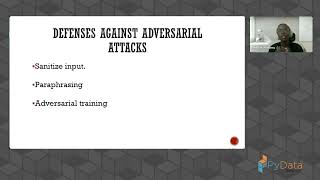 21mTricking Neural Networks : Explore Adversarial Attacks
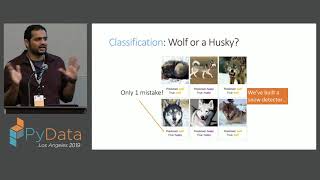 48mKeynote – Sameer Singh
 34mNeural networks: insane in the membrane
 45mTensorflow, there is no spoon