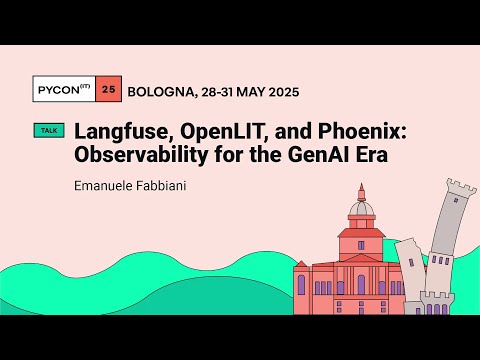
Langfuse, OpenLIT, and Phoenix: Observability for the GenAI Era
summary
Demonstrates an end-to-end GenAI observability stack: a movie-search pipeline using LanceDB + Polars, parallel semantic searches (query vs hypothetical-document embedding), ranking and LLM generation, all traced and annotated. Shows Langfuse capturing span inputs, outputs, latencies and token counts and requires Langfuse requires @observe decorators and its own OpenAI client; contrasts Phoenix which Phoenix auto-instruments via OpenTelemetry and needs only metadata injection. Example trace records 1.66s generation — 65 prompt tokens, 28 answer tokens and the storage flow LanceDB + Polars + OpenAI embeddings.
AI-written summary · about
chapters (5)
- 0:00What is observability?
- 7:56Why GenAI needs observability
- 11:55Demo with Langfuse
- 21:05Phoenix vs Langfuse
- 25:27Q&A on tools and hallucinations
related talks
 30mTutorial: Building an Observable AI Agent With an Open Source Stack
 01h 00mPrompt Failures and Latency Spikes: Observability for AI
 20mGenAIOps - OpenSearch for AI & GenAI Platform Observability
 24mHow OpenTelemetry Helps Generative AI
 32mEnd-to-End Observability for LLM Inference: From Token To GPU
 24mSkill issue: Lessons from skilling up coding agents to use Langfuse
 01h 02mObserving AI Applications with OpenLit and OpenTelemetry
 16mWhat Did the AI Just Do?: Making LLMs Observable with Open Telemetry