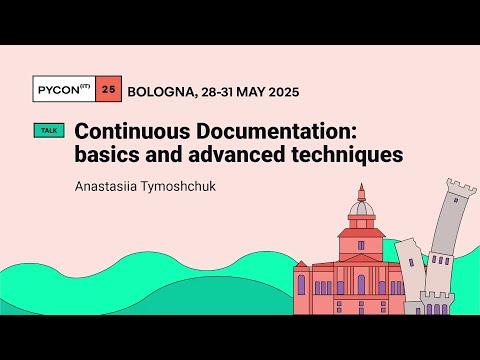
Continuous Documentation: basics and advanced techniques
summary
A single-source doc site using sphinx and hosting on Read the Docs becomes the canonical place, with CI checks (fail the PR if docstrings or percentage coverage from interrogate drop) and a rule to update docs on every or every-second PR. A Jupyter-notebook workflow renders reproducible, pre-executed examples; attempted sphinx-pycript interactivity fails in current forks. A 10-person project shows code becomes unreadable after a year without these rules.
AI-written summary · about
chapters (9)
- 0:00Introduction and speaker intro
- 1:07Why documentation matters
- 3:36Choosing documentation tools
- 6:05Four types of documentation
- 10:25Building team culture around docs
- 12:10Starting with basic documentation
- 13:34Tools for continuous documentation
- 15:00Adding interactive examples
- 19:57Documentation culture and Q&A
related talks
 36mBuilding Docs like Code: Continuous Integration for Documentation
 25mBuilding Docs like Code: Continuous Integration for Documentation
 07mContinuous Documentation
 01h 06mDocument your code
 44mPushing documentation (so it doesn't hurt anymore)
 59mTransforming your Documentation Process
 35mThe practical implementation of Documentation as Code
 40mDocumenting Python Code