The eye of the Python, an eye tracking system. From zero to...

summary
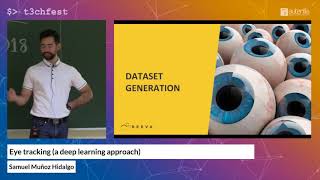
Webcam-based eye tracking is built end-to-end: a Pygame score-and-play game generates ~3,000 labeled images then augmentation multiplies that to ~90,000 samples; facial landmarks (68 points) and cropped 32×32 eye images become features; models trained with TensorFlow and Keras compare a simple dense regression, a twin-features attempt, and a CNN (best validation loss) but the simplest baseline gives the most stable real-time control. Real-world output uses PyAutoGUI for cursor, supports scrolling and map-centering, and struggles with glasses, dark irises and blink noise.
AI-written summary · about
chapters (5)
- 0:00Start
- 11:09Validation Loss
- 12:02Convolutional Network Model
- 27:40Tying the Weights to One another for the Convolutions of the Left Eye and the Right Eye
- 29:14Error Functions
related talks
 48mEye Tracking (a Deep Learning Approach)
 21mLeveraging Python for Real-Time Image processing
 29mSeeing with Python
 36mThe Neuroscience Lab
 16mEye-Trace: Segmentation of Volumetric Microscopy Images with Eyegaze
 36m"Lights, camera, AI!" - Automated sports videography
 01h 12mBuilding a live face recognition system
 49mReal Time Face Detection through a Webcam Using AI