Preview: Storage

summary
Survey of storage work covers ZNS device interfaces that cut the block‑interface tax and raise throughput/capacity; an enhanced ZNS offloads compaction to devices; a two‑bit calibrated interrupts hint yields ~40% higher throughput and ~86% lower latency; pushing indexing and crash logic into devices (KV interfaces) slashes IO amplification; zjournal achieves up to 4,000% faster journaling; logic counters give up to 65× shared‑read throughput; x‑fuse reaches >8 GB/s user‑space performance.
AI-written summary · about
chapters (15)
- 0:00Intro
- 0:26Introduction to storage systems
- 1:59Research challenges in local file systems
- 4:40Research challenges in distributed file systems
- 7:30ZNS: Avoiding the Block Interface Tax for Flash-based SSDs
- 9:32ZNS: Advanced Zoned Namespace Interface For Supporting In-Storage Zone Compaction
- 11:10Optimizing Storage Performance with Calibrated Interrupts
- 13:20Modernizing File System through In-Storage Indexing
- 15:22Re-architecting Linux Storage Stack for Low Latency and High Throughput
- 16:52LODIC: Logical Distributed Counting for Scalable File Access
- 18:30Z-Journal: Scalable Per-Core Journaling
- 20:11MapperX: Adaptive Metadata Maintenance for Fast Crash Recovery of DM-Cache Based Hybrid Storage Devices
- 22:02Max: A Multicore-Accelerated File System for Flash Storage
- 23:21XFUSE: An Infrastructure for Running Filesystem Services in User Space
- 24:48Boosting Full-Node Repair in Erasure-Coded Storage
related talks
 16mZNS: Avoiding the Block Interface Tax for Flash-based SSDs
 52mHow ZNS SSD's Are Changing the Landscape
 01h 07mEmerging Embdedded Memories and Storage
 46mZMS a New Lightweight Storage System
- 46mZMS a New Lightweight Storage System
 40mLinux Storage System Bottleneck for eMMC/UFS
 50mOverview of the Linux Storage Stack
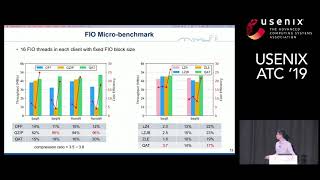 22mQZFS: QAT Accelerated Compression in File System for Application Agnostic and Cost Efficient Data Storage