Recommender Systems: Crafting Effective Personalised Experiences

summary
Explains that effective recommenders come from concrete choices: a user–item matrix with co‑occurrence and five lines in a notebook collaborative‑filtering can produce initial suggestions, production uses candidate‑generation → scoring → ordering pipelines, and IKEA’s related‑products example proves simple similarity can also fail. Claims 99% of systems rely on past consumption, cites 95% of ML pipeline failures as infra not models, recommends offline hit‑rate and ranking metrics, randomized A/B (and exploration/randomization) and shows LLMs as profile/context enrichers rather than full replacements.
AI-written summary · about
chapters (10)
- 0:00Recommender systems intro
- 1:11What is a recommender system
- 4:44Recommender fundamentals
- 10:08Building infrastructure
- 13:38From models to systems
- 16:28Evaluating systems
- 27:27Testing and deploying
- 31:41Personalization and behavior
- 36:56LLMs in recommenders
- 39:24Final thoughts & Q&A
related talks
 58mRecommender Systems – A Walkthrough
 32mLet's talk about Recommendation Systems!
 28mThe Power of Personalized Customer Experiences Through AI Innovations
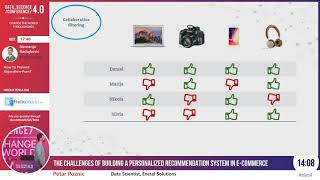 29mThe Challenges of Building a Personalized Recommendation System in E-Commerce
 34mRecommender Systems
 43mBuilding your first recommender
 37mA primer on recommendation systems.
 29mRecommender Systems for Personalized Financial Advice