Using Long Term Stable Kernel for the Embedded Products

summary
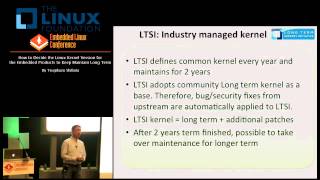
Claims that LTS delivers thousands of community backports—e.g. 4.9 ≈ 4,800 fixes, 4.4 ≈ 5,600 fixes—making it the practical base for long-lived embedded products. LTSI packages a curated annual LTS tree with shared test results and LTSI yearly tree + Yocto 2.4 integration to reduce in‑house patching. Roadmap targets 4.14 → LTS → LTSI with a June patch window and August release. Production tools discussed include Project Treble separates vendor kernel bits, livepatch (kpatch/kGraft on supported platforms) and dual‑partition + Omaha‑style updates.
AI-written summary · about
chapters (26)
- 0:00Introduction
- 0:27Topics
- 0:49Who am I
- 3:47Release dates
- 5:04Development
- 5:44Release Schedule
- 6:31Source Code Growth
- 7:00Rapid Release Cycle
- 7:43Long Term Stable Kernel
- 8:33Latest Status
- 9:10Long Term Stable
- 10:34LTS Versions
- 12:22Stable Versions
- 14:34What is LTSI
- 15:36LTSI vs 80s
- 16:50LTSI History
- 19:52LTSI Release
- 20:59Lessons Learned
- 23:05Fast Policy
- 28:20Patching
- 29:26Update mechanism
- 30:37Container OS
- 32:10Decius
- 32:43Next 2 Years
- 35:20Conclusions
- 35:52QA
related talks
 43mUsing Linux as Long Term Working with the Community
 34mHow to Decide the Linux Kernel Version
 34mDelivering Security Fixes Continuously Into Your Embedded Linux
 47mUpstream LTS Component for Product Delivery
 41mThe Kernel Report
 41mChallenges Around Long-Term Kernel Maintenance
 39mTowards Sustainable Systems with the Civil Infrastructure Platform
 24mContinuously Integrating the Upstream Linux Kernel on Hardware