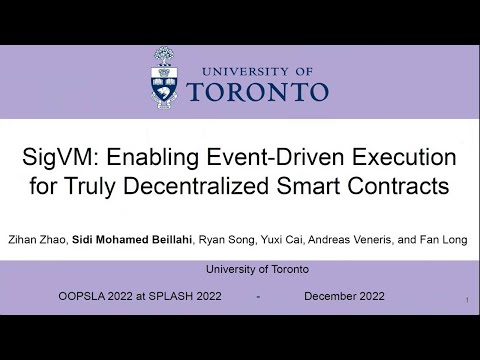
SigVM: Enabling Event-Driven Execution for Truly Decentralized Smart Contracts
summary
SigVM extends EVM with five primitives to create/delete signals, bind/detach handlers and emit events, making handlers execute automatically as signal transactions; implementation includes an incentive scheme where binders pay gas (evaluation uses a 0.1 gas‑incentive ratio) and a configurable cap of 1/10 block gas for signals. An end‑to‑end SigChain platform and SigSolid compiler reimplement 23 contracts from 13 DApps with only 3.17% average code change and negligible runtime and gas overhead.
AI-written summary · about
chapters (22)
- 0:00SigVM and team intro
- 1:03Blockchain and Ethereum basics
- 2:51Event-driven smart contract limits
- 4:21MakerDAO liquidation failure case
- 6:07Augur prediction market delays case
- 6:50SigVM event-driven execution
- 8:36Signal events and handlers
- 10:26Buffer periods and async comms
- 11:52Delay enforcement simplification
- 13:19Gas fees for signal transactions
- 14:43Spurious event protection
- 16:52SigVM evaluation setup
- 17:56New primitives and compiler
- 18:39Benchmarking smart contracts
- 19:44Runtime overhead results
- 20:27Gas efficiency evaluation
- 21:31Conclusion
- 21:53Q&A
- 22:14Handler execution guarantees
- 24:01Comparison with other chains
- 25:26Preventing event spoofing
- 26:31Deadlock and DoS handling
related talks
 13mEVVM Transactions & Functions for Beginners
 11mSWIG Smart Wallet: Engineering for Efficiency
 16mSVM: The Power of Solana Beyond the Blockchain
 01h 25mSpeculation in Smart Contracts
 15mHEMVM: a Heterogeneous Blockchain Framework for Interoperable Virtual Machines
 13mVVISP: A Smart Way to Operate Smart Contracts
 21mHitchhiker’s Guide to the EVM
 22mGetting to Next-Gen Decentralized Governance