Monadic and Comonadic Aspects of Dependency Analysis
summary
Presents GMCC, an alternative dependency calculus that is both monadic and comonadic, built from graded monads/comonads over a bicartesian closed category and shown sound and complete against a class of categorical models. Shows a translation proving GMCC under 13 restrictions is equivalent to a terminating fragment of DCC, explains DCC’s nonstandard bind and protection judgment as instances of monad algebras, and gives novel soundness proofs using monoidal functors; GMCCE then subsumes DCC and λ◦.
AI-written summary · about
chapters (5)
- 0:00Start
- 0:50Dependency Analysis: Basics
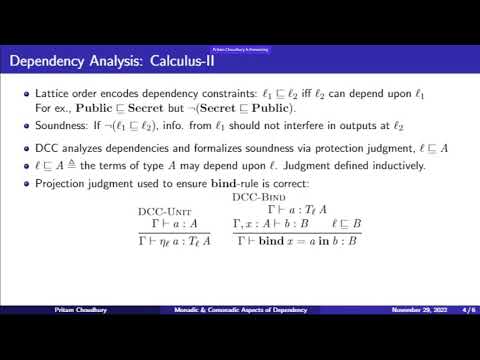
- 4:21Dependency Analysis: Calculus-II
- 10:39DCC: Limitations and Our Contributions
- 12:12Our Key Insights
related talks
 19mCombining Dependency, Grades, and Adjoint Logic
 34mGraded Monads and Type-Level Programming for Dependence Analysis
 34mAdditive Cellular Automata Graded-Monadically
 15mMonadification of Attribute Grammars
 27mThe Relative Monadic Metalanguage
 27mPractical Extensions for Graded Monads
 14mRecovering Purity with Comonads and Capabilities
 24mClassical Notions of Computation and the Hasegawa-Thielecke Theorem