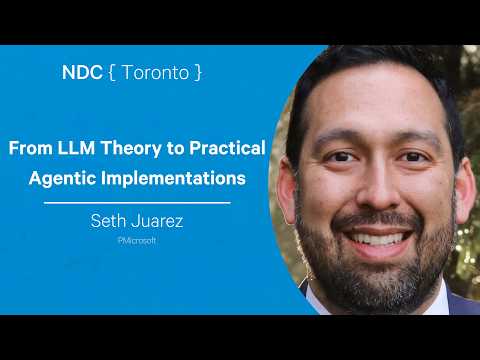
From LLM Theory to Practical Agentic Implementations
summary
Claim: LLMs are fundamentally a next-token predictor and have no independent agency; agency comes from the runtime. The demo uses the Prompty library and Draft Flow app to show nine progressive modes: plain completions, structured JSON outputs, chat threads, function-style tool calls and an agentic loop that executes tools (fetch, setTitle, setContent), a memory tool that stores per-user data, guardrails that block cross-user reads, and bindings plus steering and composition workflows — all implemented and shown working with live traces and a public repo.
AI-written summary · about
chapters (12)
- 0:00Introduction to AI primitives
- 2:17How LLMs work and train
- 4:10Draft Flow app overview
- 7:44Simple text generation
- 14:10Structured output
- 18:59Chat and threads
- 25:32The agentic loop
- 41:17Memory as a tool
- 45:13Guardrails and policy
- 48:08Scoped tool bindings
- 50:38Steerable agent loops
- 53:54Workflow composition
related talks
 01h 43mBuilding LLM Agents (Hackathon)
 26mContext Engineering: Practical Techniques for Improving Agent Quality Today
 16mLLMs are not the product
 39mLLMs everywhere: The future is now and the past keeps repeating itself
 01h 39mMastering LLMs: From Prompt Engineering to Agentic AI
 35mBuilding LLM-based Agents
 36mLLMs and AI agents demystified
 17m12-Factor Agents: Patterns of reliable LLM applications