Keep you data safe in a containerized application

summary
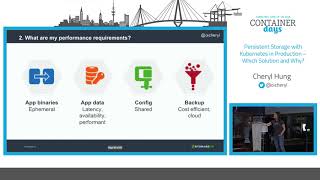
Containers boot in about 0.5–1s and images are immutable, so the recommended pattern is never to keep critical state inside the container but on external stores. Options compared: ephemeral in-container files (fast, not durable), host-mounted volumes (fast, lost if host dies), and networked storage like NFS or cloud blobstores (durable, may add latency). Example: built GeoServer on Tomcat as a container and used an NFS volume mounted with -v to persist map data; it works. Clustered services (Elasticsearch) rely on replication, and S3/NFS suit critical durable data.
AI-written summary · about
chapters (23)
- 0:00Intro
- 1:18Agenda
- 2:11Introduction
- 3:50Containerized application
- 8:36Containers
- 11:52How to build containers
- 14:15Benefits of using containers
- 16:57Challenges
- 17:34Compute
- 20:00Network
- 22:03Storage
- 23:26Storage options
- 23:48In container storage
- 26:16Elastic Search
- 27:35Hostbased storage
- 31:00Load harasser
- 31:48External storage
- 34:58Use case
- 35:41Gale Server
- 36:45Solution
- 37:37Datastore
- 39:06Container design
- 40:42Questions
related talks
 06mIgnites- Containers, Virtual Machines...
 25mBlazing-Fast Container Deployments: Image Caching With Block Storage
 48mContainer: check! Aber wohin mit Persistent Data, Big Data oder Fast Data?!
 38mThe Container Operator’s Manual
 22mCloud Native GIS - The value of development velocity in GIS
 28mPersistent Storage with Kubernetes in Production - Which Solution and Why?
 38mDocker and Databases
 35mChallenges of running data stores in containers