Using Deep Reinforcement Learning for Dialogue Systems

summary
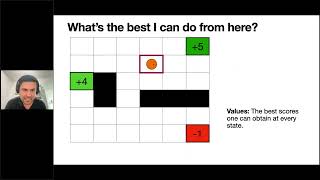
Describes training a dialogue policy with deep reinforcement learning using DQN variants and an actor‑critic baseline, adding experience replay and a slowly updated target network to stabilize learning. Training uses a two‑phase pipeline: fit a user simulator from offline logs, then train the policy in simulation. Evaluation uses +1 reward for success, −1 for failure and a small per‑turn penalty; a usable policy emerges after a couple hundred training dialogues and pre‑training further reduces sample needs.
AI-written summary · about
chapters (9)
- 0:00Introduction to speaker
- 0:28Dialogue system pipeline
- 2:08Reinforcement learning basics
- 3:22RL vs supervised learning
- 6:23Advantages and challenges
- 8:34Solution strategies
- 14:34Deep reinforcement learning
- 16:26Applying RL to dialogue
- 19:14Results and conclusion
related talks
 01h 17mTraining intelligent game agents using deep reinforcement learning
 30mReinforcement Learning - ChatGPT, Playing Games & More
 42mReinforcement Learning using Generative Models for Continuous State and Action Space Systems
 33mBuilding the next-generation Conversational AI with Python and Deep Learning
 05mPractical insights into deep reinforcement learning
 33mBreakthroughs and the Future of (Deep) Reinforcement Learning
 56mA Tutorial on Reinforcement Learning II
 29mReinforcement Learning with Human Feedback