Using Bayesian Optimization to Tune Machine Learning Models
summary
Argues that Bayesian global optimization (Gaussian-process surrogate with expected improvement acquisition) finds better hyperparameters with far fewer costly model runs than grid or random search, and shows an ensemble service (SigOpt) that wraps open-source tools and MO to do this in production. Describes a robust benchmark suite of hundreds of problems (≈600 functions and real datasets), reports SigOpt beating particle swarm on a noisy 3‑D function and ranking competitively across classes.
AI-written summary · about
chapters (20)
- 0:00Intro
- 0:56OUTLINE
- 2:32TUNABLE PARAMETERS IN DEEP LEARNING
- 5:33EXAMPLE: FRANKE FUNCTION
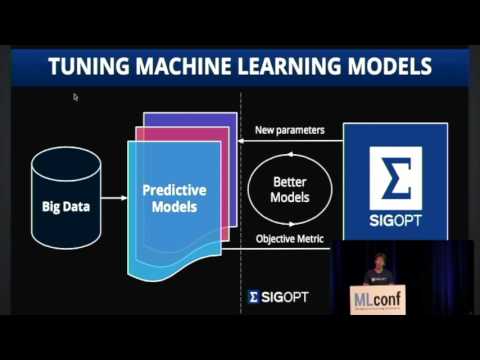
- 7:33TUNING MACHINE LEARNING MODELS
- 8:16OPTIMAL LEARNING
- 9:04BAYESIAN GLOBAL OPTIMIZATION
- 10:36HOW DOES IT WORK?
- 11:36GAUSSIAN PROCESSES
- 14:56EXPECTED IMPROVEMENT
- 17:30METRIC: BEST FOUND
- 17:45METRIC: AUC
- 18:19BENCHMARK SUITE
- 19:13INFRASTRUCTURE
- 20:13METRICS: STOCHASTICITY
- 20:32RANKING OPTIMIZERS
- 21:24RANKING AGGREGATION
- 22:16HOW DOES SIGOPT INTEGRATE?
- 22:56SIMPLIFIED MANAGEMENT
- 23:20ADDITIONAL TOPICS
related talks
 41mOptimizing Machine Learning Models
 28mBayesian Optimization- Fundamentals, Implementation, and Practice
 34mBayesian Optimization and it's application to Neural Networks
 18mAlexandra Johnson, Software Engineer, SigOpt, NYC 2017
 18mBest Practices for Hyperparameter Optimization
 26mAddressing Some of Challenges When Optimizing Long-to-Train-Models
 48mBayesian Optimization of Gaussian Processes with Applications to Performance Tuning
 39mBayesian optimisation with scikit-learn