Analysis of Nakamoto Consensus

summary
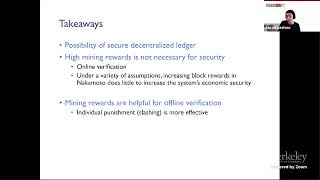
Proves a short explicit condition for safety and liveness: honest mining beats adversary when alpha times an exponential-in-delta factor exceeds beta, with safety failure probability shrinking exponentially in commit depth K. Model uses continuous-time Poisson process mining, a message delay bound delta that the adversary can schedule within [0,delta], and counts non-tailgater and loner honest blocks to show honest useful-block rate > malicious rate. Analysis uses Chernoff bounds and Erlang timing; entire proof fits in about two and a half pages.
AI-written summary · about
chapters (9)
- 0:00Introduction
- 0:43What is Consensus
- 1:25Overview
- 2:29Proof
- 9:27Model
- 16:36Key Idea
- 19:14Useful Blocks
- 22:30Summary
- 23:47Safety
related talks
 51mEconomic Security of Distributed Systems
 30mCan Private Proof-of-Stake Blockchains Obtain All of Safety, Liveness, and Privacy?
 40mBitcoin Selfish Mining and Dyck Words
 42mStochastic reasoning in decentralised systems
 52mGame-Theoretically Secure Protocols Inspired by Blockchains
 33mByzantine generals: How the blockchain solves the distributed consensus...
 01h 11mDemystifying Bitcoin
 47mCant we just agree