Chaos Debugging: Finding and Fixing Microservice Weak Points

summary
Demos show three specific tools and concrete results: Squash attaches gdb/dlv/Java debuggers to live Kubernetes containers and patches memory to fix a calculator bug on the fly; Loop records full request transactions in the sidecar, buffers them, only uploads on error and replays the exact failing inputs into a debugger; Gloo Shot injects faults via any service mesh, watches Prometheus thresholds to abort experiments, and verifies a resilient deploy removes cascading 500s.
AI-written summary · about
chapters (13)
- 0:00Chaos debugging intro
- 3:46Debugging with Squash live
- 6:46Squash for distributed debugging
- 10:22Safe production debugging
- 11:45Tracing trade-offs
- 13:31Service Mesh Interface problems
- 16:23Capturing bugs with Loop
- 19:42Loop’s open-source replay
- 20:47Chaos as control system
- 23:18Fault injection with Blue Shot
- 25:11Blue Shot demo
- 29:35Service Mesh Interface start
- 32:27Tools and projects summary
related talks
 50mTroubleshooting & Debugging Microservices in Kubernetes
 43mDebugging and Troubleshooting Microservices
 50mTroubleshooting & Debugging Microservices in Kubernetes
 26mDebugging Clojure Services Under Stress
 42mMicroservice Testing Techniques
 41mDebugging an Application with Service Mesh
 25mDebugging at Scale in Production with kubectl debug
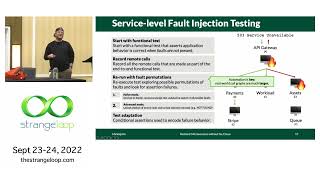 41mResillient Microservices without the Chaos