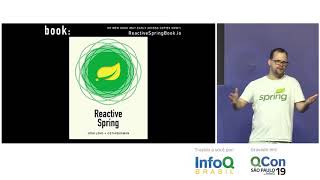
Reactive Spring

summary
Reactive claim: less threads, backpressure, uniform APIs and fault-handling. Demo builds a customers HTTP service (Spring Boot 2.4, Spring Boot 2.4 + Reactor, reactive Spring Data repo via R2DBC + H2), an orders service over RSocket streaming, and a gateway that composes customer+orders with Flux.zip. Uses WebClient, Spring Cloud Gateway, hedging and retries, BlockHound for detecting blocking, and native-image Docker build that boots in ~0.176s. The composed customer-orders materialized view runs end-to-end and returns streamed results.
AI-written summary · about
chapters (19)
- 0:00Introduction
- 3:07Why reactive programming
- 5:52Limitations of blocking IO
- 7:49Reactive paradigm benefits
- 9:45Handling distributed systems
- 11:49Spring Boot and GraalVM
- 13:49Application setup
- 17:12Reactive streams API
- 21:25Mono and Flux
- 22:50Database interaction
- 26:34HTTP endpoints
- 29:16RSocket protocol
- 32:20Building the order service
- 35:30Api gateway configuration
- 37:28Service orchestration
- 40:34Error handling and hedging
- 43:23Materialized view demo
- 46:17Summary
- 47:18Q&A session