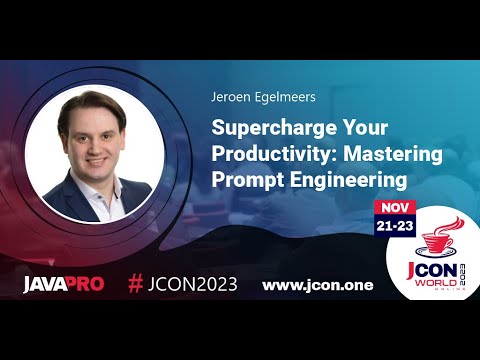
Supercharge Your Productivity Mastering Prompt Engineering
summary
A practical framework called Crafting AI Prompts Framework breaks prompt work into three phases—crafting, validation, enhancement—and prescribes concrete fields: context register acting role format task. Examples show copying long video transcripts, chunking them, and asking ChatGPT for timestamps; using placeholders to avoid NDAs; requesting image seed numbers; storing prompts as recipes for Java apps; and integrating IDE assistants (IntelliJ) to refactor code, write docs, and replace rubber‑ducking with GPT ducking while warning to validate hallucinations.
AI-written summary · about
chapters (21)
- 0:00Introduction to prompt engineering
- 1:47Why learn prompt engineering
- 2:47Prompt engineering framework overview
- 5:58Crafting AI prompt framework
- 7:00Crafting phase explained
- 9:07Context in prompts
- 10:51Register and acting roles
- 13:46Format and task specificity
- 16:35Building a complete prompt
- 16:56Validation phase details
- 19:44Goal-driven validation
- 21:12Output validation and refinement
- 23:21Enhancement phase tips
- 24:46Staying updated on AI tools
- 25:30Example LinkedIn post prompt
- 28:43Non-disclosure in prompts
- 30:30YouTube transcript optimization
- 35:05AI in IDEs for Java developers
- 38:19Code review and documentation
- 40:28Rubber ducking with AI
- 42:17Cheat sheet and closing
related talks
 29mSupercharge Your Productivity: Mastering Prompt Engineering
 47mThe Art of Prompt Engineering: Best Practices for Effective AI Interactions
 19mDouble your Productivity at Work using these 3 GenAI Prompt Strategies
 48mStop Fighting Your AI Engineering Prompts That Actually Work
 28mAI Prompt Engineering to Customer Engagement: the Evolution of Effective Content
 16mPrompt Engineering for Testers: Types and Applications
 02h 01mPrompt Engineering and AI Red Teaming
 01h 56mPrompt Engineering: The Path to Effective Work with ChatGPT