Panel on Interpretability in the Physical Sciences

summary
Panel shows concrete methods: variational optimization of an optimal force (solution of a backward/Governorov-type equation) to drive and analyze rare molecular events, then project that high-dimensional control into simple coordinates (e.g., an effective electric field for water autoionization). Work combines linear, kernel and deep representations, uses KL regularization for physicality, applies maximum entropy correction to align simulations with scattering data, and estimates reliability with model committees and active learning; tests report improved sampling rates and interpretable reaction coordinates.
AI-written summary · about
chapters (4)
- 0:00Start
- 34:52Bottom-Up Approaches and Top-Down Approaches
- 35:46Trend of Top Down versus Bottom Up
- 50:13Self-Averaging Behavior
related talks
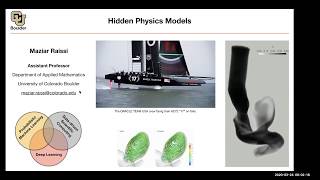 01h 11mHidden Physics Models: Machine Learning of Nonlinear Partial Differential Equations
 01h 10mBayesian Optimization and Machine Learning for Accelerating Experiments in the Physical Sciences
 34mPanel Discussion: Training and Inference at Planet Scale
 26mPanel Discussion
 01h 07mConsensus-Based Interacting Particle Systems and Mean-field PDEs for Optimization and Sampling
 59mKeynote Panel AI in Quantum Computing
 51mRandom Projections for Probabilistic Inference
 56mWrap up and reflection talk