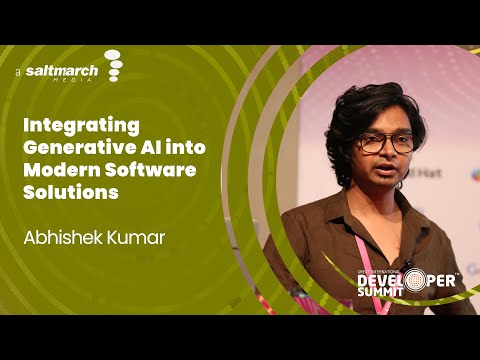
Integrating Generative AI into Modern Software Solutions
summary
Covers concrete integrations: uses RAG with vector DBs (Pinecone, vv8) for code search, VS Code plugins like CodeGPT and GitHub Copilot for explanation, refactoring, tests, and Docker/Terraform generation, and runs local Llama 3 instances or Grock LPU to avoid external APIs. Reports running ~100 experiments and measuring 20–40% reduction in idea‑to‑live time, builds like backlog‑AI and fine‑tuned adapters to cut inference cost, and flags latency, data‑privacy, IP and guardrail requirements with practical deployment options.
AI-written summary · about
chapters (15)
- 0:00Introduction to GenAI in software
- 2:49Generative AI opportunities overview
- 6:18SDLC stages and AI integration
- 8:02Ideation phase with GenAI tools
- 10:48Planning phase automation
- 13:37Building phase with AI assistance
- 27:07Advanced code generation use cases
- 31:02Operating phase automation
- 33:52Architectural considerations for GenAI
- 37:42Data privacy and security challenges
- 41:09Copyright and IP considerations
- 45:26Personalization and fine-tuning models
- 49:37Deployment options for GenAI tools
- 52:50Future trends in GenAI for SDLC
- 57:46Conclusion and key takeaways
related talks
 40mDavid Fogl: Leveraging Generative AI for Enhanced Software Testing
 46mAI Integration for Devs: ChatGPT and Copilot in Your Projects
 38mIntegrating Generative AI for Quality Eng. Into The Software Lifecycle
 21mRevolutionizing software creation: Harnessing the power of GenAI
 29mImpact of #GenerativeAI in Development and #SoftwareTesting
 36mUnleashing Generative AI: Improving Developer Productivity in SRE
 30mIncorporating AI into your SDLC
 24mAIGenOps: Integrating Generative AI into Platform Engineering