Extreme Object-Oriented Ruby
summary
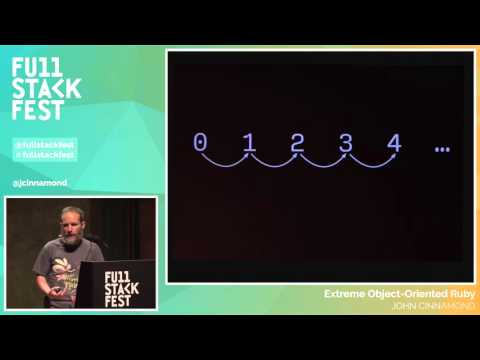
Claims that Ruby can be restricted to a pure OO numbers model and that keywords like if are unnecessary; implements numbers as Zero and Successor objects, defines + and == by delegating to predecessors, and models true/false as objects so conditional logic becomes an object-if pattern. Uses only defining classes instantiating objects storing references and sending messages and maps lambda calculus into those objects. Rebuilds arithmetic and boolean logic successfully but discovers no IO and eager evaluation issues that prevent full parity.
AI-written summary · about
chapters (14)
- 0:00Start
- 1:05The if Keyword Is Not Necessary in Ruby
- 2:21Primitive Objects
- 4:16Ground Rules
- 27:04Eager Evaluation
- 27:31Delay Execution
- 30:37Strings
- 30:59Character Class
- 35:49Lambda Calculus
- 36:20London Structions
- 36:56Lambda Application
- 37:56The Lambda Calculus
- 40:34Understanding Computation by Tom Stewart
- 46:38Ada Lovelace