Gain more confidence in your code with mutation testing

summary
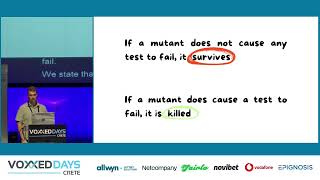
Mutation testing mutates source code, runs unit tests, and reports which mutants survive or are killed, producing a concrete mutation coverage percentage that measures test strength rather than line coverage. At ING the workflow changes from running the whole suite for every mutation to a tool that detects only changed classes and drops runtimes from 30–40 minutes to 1 minute. The claim: higher mutation coverage makes refactors safer; the implementation detail and the measured speedup decide whether to adopt it.
AI-written summary · about
chapters (15)
- 0:00Introduction
- 1:04Why mutation testing matters
- 3:32Unexpected failures
- 4:56Mutation testing in practice
- 7:27Real-world mutation example
- 8:51Interpreting reports
- 10:36Improving tests with insights
- 11:20Testing pyramid
- 12:43Mutation vs code coverage
- 14:34Confidence through strong tests
- 15:59Demo offer
- 16:20Q&A: scope and coverage
- 17:46Q&A: performance and tools
- 20:14Q&A: mocking and boundaries
- 23:45Closing
related talks
 41mMutation testing in practice
 38mMutants to the rescue: How effective are your unit tests?
 31mSilence of Code Coverage – Time to Test the Tests
 37mAre your tests good enough?
 46mTest Your Tests Before They Betray You: Mutation Testing!
 07mWho is Testing the Tests?
 50mFrom jUnit to Mutation-Testing
 27mRe-thinking Regression Testing