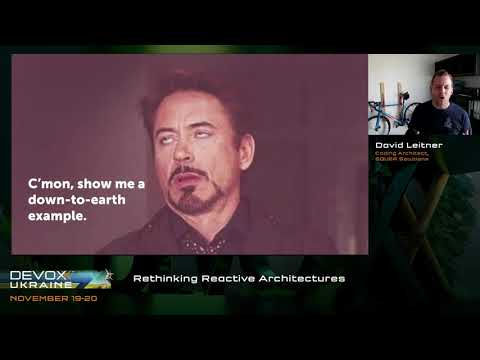
Rethinking Reactive Architectures
summary
Argues that making systems stream-centric with Kafka (or Pulsar), event stores, CQRS projections and GraphQL subscriptions moves from pull to push, enabling horizontal scaling and resilience; gives a working insurance demo using websockets and event store plus GraphQL subscriptions to sync agents and customers in real time. Cites a banking finding that ~93% of mobile users only view balance/transactions, so co-locating read projections yields high availability and UX gains at the cost of added complexity and eventual-consistency tradeoffs.
AI-written summary · about
chapters (13)
- 0:00Introduction
- 1:16What is reactive programming
- 8:18Real-world reactive example
- 11:05Why reactive architecture
- 13:29Reactive Manifesto explained
- 15:53Message-driven systems
- 20:06From pull to push architecture
- 24:21Event sourcing basics
- 27:50Autonomous microservices
- 31:48Entity service antipattern
- 37:09Daily use cases
- 45:53Benefits and trade-offs
- 47:16Conclusion and Q&A
related talks
 01h 17mReacting to an Event-Driven World.
 01h 00mReacting to an Event-Driven World
 35mFunctional distributed systems beyond request/response
 27mFour Principles of Reactive Architectures
 39mReacting to an Event-Driven World
 01h 11mReactive Architecture Patterns Debate
 34mReactive Architecture
 01h 25mBuilding microservices with event sourcing and CQRS