Understanding and Using AI Language Models
summary
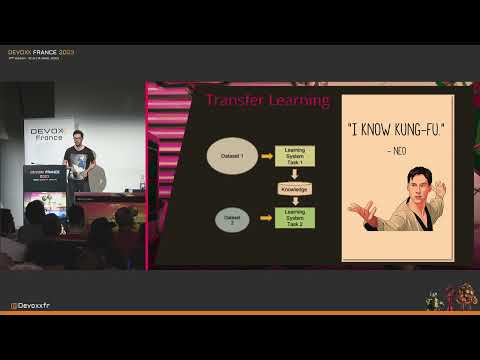
The talk explains how pretraining followed by fine-tuning drastically reduces labeled-data needs (claimed up to 100×), noting key model sizes like GPT‑1 (110M), GPT‑3 (175B) and GPT‑4’s larger 8k–32k context windows. It demonstrates practical tools—Hugging Face, PyTorch, AWS, vector databases, Trainer, DistilBERT—and presents a six‑month Sparklane project that built multi‑vector embeddings plus a multimodal scorer for text and tabular data, with a ~10‑hour training pipeline (~€50) and real‑time GPU costs (~€100/month) that produced modest (single‑digit percent) accuracy gains at higher cost and maintenance complexity.
AI-written summary · about
chapters (8)
- 0:00Introduction
- 1:04What is a language model
- 29:38Practical use of models
- 1:00:00Generative models and GPT-2
- 1:27:50Chatbots and model alignment
- 2:14:44Augmented models and agents
- 2:30:10Use cases and productivity
- 2:49:31Conclusion
related talks
 39mCollect Data to Fine-Tune Your Large Language Model
 29mHow AI Models Get Smarter
 01h 00mInside GPT – Large Language Models Demystified
 47mThe Rise of AI: A Reality Check on Generative AI
 47mInside GPT – Large Language Models Demystified
 30mLarge Language Models and Prompt Engineering for Developers
 27mLarge Language Models and the Future of AI
 51mLarge Language Models for Real-World Applications - A Gentle Intro